
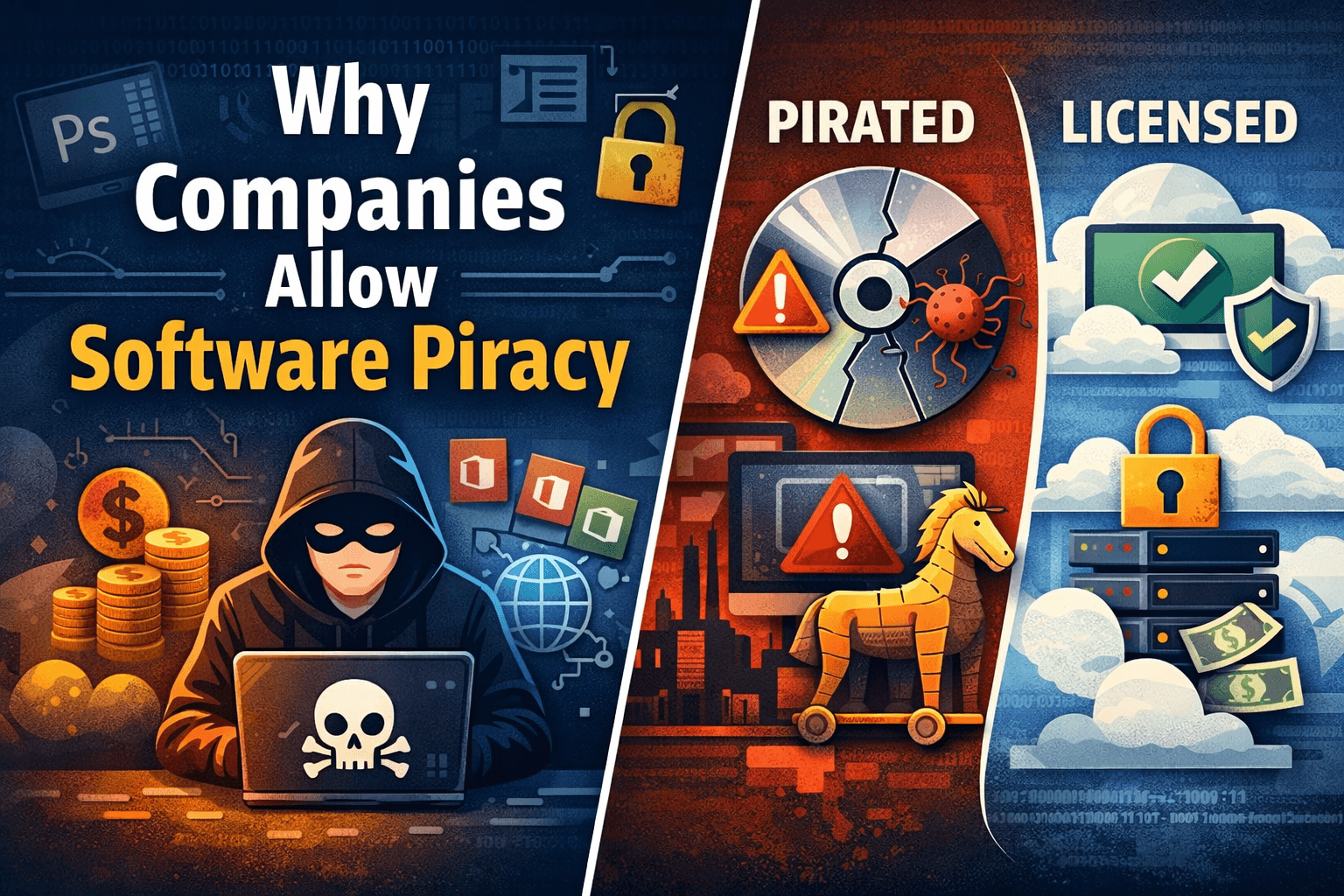
Software piracy has existed for decades, yet global tech giants like Microsoft, Adobe, and Autodesk still dominate the market. This raises a critical question: why companies allow software piracy instead of eliminating it completely?
At first glance, piracy looks like a loss—millions of users accessing expensive software without paying. But when we analyze the software industry more deeply, a different picture emerges. In many cases, piracy is not ignored by accident. It is tolerated for strategic, economic, and psychological reasons.
This article explores why companies allow software piracy, how it supports market dominance, the risks it creates for users, and why the industry is now shifting toward subscriptions and cloud-based control.
⚠️ Disclaimer (Important)
This article is for educational and informational purposes only. It does not promote, encourage, or support software piracy or the use of unauthorized software.
The purpose of this content is to analyze the economic, technical, and business realities of the software industry while highlighting risks, legal concerns, and long-term consequences.
Why Companies Allow Software Piracy in the First Place
To understand why companies allow software piracy, we must first separate individual users from commercial organizations.
From a business perspective, chasing individual users across different countries, legal systems, and economic conditions is expensive, slow, and often unprofitable. Instead, software companies focus on long-term market control rather than short-term losses.
This approach transforms piracy from a threat into a strategic variable.
“Read Also: The OpenAI Bubble“
Habit Formation: A Key Reason Why Companies Allow Software Piracy
One of the strongest reasons why companies allow software piracy is habit formation.
Learning Before Paying
Consider creative software such as professional image-editing tools. These platforms require time to master:
- Interface layout
- Keyboard shortcuts
- File structures
- Workflow logic
If beginners and students cannot access these tools early, they will naturally migrate to free alternatives. Over time, this creates a new generation trained on competing platforms.
From a corporate standpoint, allowing limited or uncontrolled access during the learning phase helps ensure that future professionals remain locked into the same ecosystem.
When those users later enter the workforce, businesses—not individuals—pay for official licenses.
“Read Also: Google Workspace Pricing Plans“
Why Companies Allow Software Piracy to Protect Market Share
Market dominance is often more valuable than direct sales.
The Network Effect
Software becomes more powerful when:
- More people use it
- File formats become standard
- Compatibility becomes essential
This is one of the strongest explanations for why companies allow software piracy at scale.
If everyone uses the same tools, alternatives struggle to survive. Developers build for the most common platforms. Businesses standardize workflows. Training materials follow the dominant software.
Over time, the market locks itself.
Microsoft and the Global Software Standard
Historically, Microsoft products became the global standard for operating systems and office productivity.
By tolerating widespread unauthorized usage in developing markets and among individuals, Microsoft ensured that:
- File formats became universal
- Businesses required compatibility
- Alternatives faced adoption barriers
As a result, even users who never paid directly contributed to Microsoft’s dominance by reinforcing its ecosystem. This strategy highlights how software piracy can indirectly strengthen corporate power.
“Read Also: Google Ads Campaign Structure“
Free Trials That Never End: A Strategic Design Choice
Some software products famously allow extended trial use without strict enforcement.
From a business perspective, this approach:
- Increases brand recognition
- Encourages widespread adoption
- Normalizes the software as the default choice
While individual users may never pay, enterprises and organizations often must comply with licensing laws, audits, and regulations. These organizations generate the majority of revenue.
Once again, why companies allow software piracy becomes clearer when revenue sources are examined closely.
Data Collection and Pirated Software: An Overlooked Reality
Another sensitive aspect of software piracy involves usage data.
Even unauthorized copies may still:
- Generate crash reports
- Send anonymized diagnostics
- Reveal usage patterns
Unless advanced network protections are in place, this data often reaches developers.
Free Testing at Massive Scale
From a technical standpoint:
- Bugs are identified faster
- Stability improves
- Paid users benefit from updates
Meanwhile, unauthorized users:
- Receive no support
- Miss security updates
- Face higher risks
This dynamic further explains why companies allow software piracy instead of aggressively blocking it.
Why Legal Action Targets Companies, Not Individuals
Many people wonder why large software companies do not pursue legal action against every unauthorized user.
The reasons are practical:
- Legal costs exceed potential compensation
- Jurisdictional complexity
- Negative public relations risks
Instead, enforcement focuses on:
- Businesses
- Institutions
- Commercial use
Organizations using unlicensed software face audits, penalties, and large settlements. This is where meaningful revenue recovery occurs.
The Shift to Subscriptions and Cloud-Based Control
In recent years, the software industry has significantly changed its business model.
Why Ownership Is Being Replaced by Access
Subscription systems and cloud services allow companies to:
- Centralize control
- Require online verification
- Deliver server-based features
Advanced tools such as AI-powered features, cloud collaboration, and real-time updates are now tied to online accounts. This makes unauthorized copies increasingly limited and outdated.
Instead of fighting piracy through lawsuits, companies reduce its value.
The Real Risk of Unauthorized Software: Security and Privacy
While companies may tolerate piracy strategically, users face serious risks.
Unauthorized software may include:
- Malware
- Credential theft tools
- Cryptomining scripts
- Botnet components
These threats can result in:
- Data loss
- Account compromise
- Financial damage
Many users only recognize the value of licensed software after experiencing these consequences.
The Bigger Picture: Why Companies Allow Software Piracy Is Not About Kindness
Technology companies are neither careless nor generous. They are profit-driven entities operating on long timelines.
From their perspective, unauthorized users:
- Spread brand dominance
- Train future professionals
- Reduce competitor growth
- Improve software stability
However, this does not mean piracy is safe, ethical, or sustainable for users.
Frequently Asked Questions About Why Companies Allow Software Piracy
1. Why don’t companies completely eliminate software piracy?
Because aggressive enforcement can damage adoption, push users to competitors, and harm long-term market dominance.
2. Is software piracy officially allowed?
No. It remains illegal, but enforcement is selective and strategic.
3. Do companies know when software is unauthorized?
In many cases, usage patterns and diagnostics can indicate unauthorized installations.
4. Why are businesses targeted more than individuals?
Because businesses generate real revenue and face legal compliance obligations.
5. Is using pirated software risky?
Yes. Security threats, data loss, and privacy risks are significantly higher.
Conclusion: The Real Meaning Behind Why Companies Allow Software Piracy
Understanding why companies allow software piracy reveals how modern tech businesses think beyond short-term profit. Piracy, while illegal, has historically supported adoption, ecosystem dominance, and long-term revenue growth.
However, the landscape is changing. Subscriptions, cloud platforms, and security concerns are steadily reducing the relevance of unauthorized software.
For users, the real question is no longer about cost—it is about security, stability, and trust.