
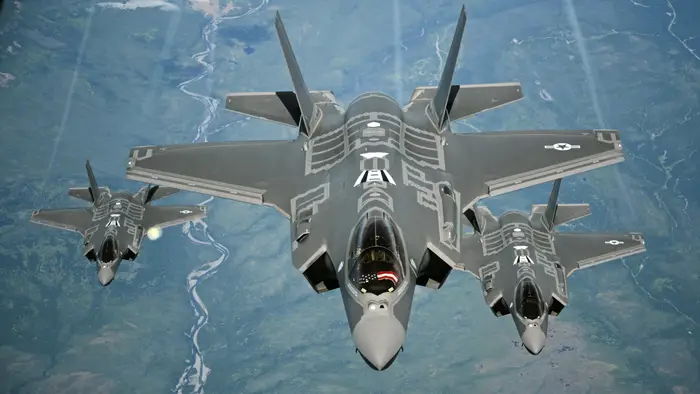
Modern warfare is increasingly defined by machines that can see before they are seen, strike before they are detected, and disappear before a response even begins. Among the most advanced examples of this technological evolution is the F-35 fighter jet, one of the most sophisticated combat aircraft ever built.
But while these machines evolve at an astonishing pace, an important question remains: Is human awareness evolving at the same speed as our technology? Humanity has mastered the engineering required to create incredibly powerful weapons, yet the challenge of controlling and responsibly using such power remains.
The F-35 fighter jet represents the peak of modern aerospace engineering. Capable of near-supersonic speeds, equipped with stealth technology, and packed with advanced sensors and weapons systems, this aircraft appears almost like a ghost in the sky. Yet behind every flight lies an extraordinary industrial process involving thousands of engineers, advanced robotics, and millions of precision components.
In this article, we will explore how the F-35 fighter jet is designed and built, from digital simulations and material engineering to final flight tests and global deployment.
The Vision Behind the F-35 Fighter Jet
Before a single physical component of the F-35 fighter jet is produced, years of research and digital development take place inside the engineering facilities of aerospace manufacturers.
More than 3,000 specialists worked for years to design this aircraft with a clear goal: to create a multi-role stealth fighter capable of performing air superiority, ground attack, and reconnaissance missions while minimizing the chances of being detected by enemy radar.
Advanced Digital Design and Simulation
Modern fighter aircraft are no longer designed primarily with physical prototypes. Instead, engineers rely on powerful 3D digital design platforms that allow them to simulate nearly every aspect of flight and combat operations.
Through these digital tools, engineers analyze:
- Aerodynamic performance
- Radar reflection and stealth capabilities
- Structural integrity under extreme stress
- Weapon integration and payload balance
- Electronic systems performance
The body of the aircraft is shaped using precise geometric angles designed specifically to deflect radar waves. Even the placement of weapons is carefully considered. Unlike older fighters that carry missiles externally, the F-35 stores its weapons inside internal bays, preserving its stealth profile.
Years of Testing Before Manufacturing
Before any real aircraft is assembled, the digital model undergoes millions of simulated combat scenarios. These tests include:
- Air-to-air combat situations
- Electronic warfare environments
- Extreme weather conditions
- High-speed maneuvering
- System failures and emergency situations
This development phase lasted more than a decade, with an estimated $60 billion spent on engineering and development alone.
Only after successfully passing all virtual tests can the program move into full manufacturing.
From Digital Blueprint to Real Aircraft
Once the design of the F-35 fighter jet is approved, the massive industrial process begins.
Every day, specialized transport trucks deliver tons of advanced materials to manufacturing facilities, including:
- Aerospace-grade aluminum
- Military-grade titanium
- High-strength carbon fiber composites
- Classified stealth materials
Many of these materials are so advanced that they are protected under strict security classifications.
Manufacturing the Wings
The wings of the F-35 fighter jet are among the most complex parts of the aircraft.
They must simultaneously:
- Store fuel
- Carry heavy weapons
- Hide sensors
- Withstand extreme combat forces
To produce these structures, massive blocks of titanium and aluminum are placed inside giant hydraulic presses capable of generating thousands of tons of pressure.
These components are then combined with carbon fiber panels, creating a structure that is:
- Lightweight
- Extremely strong
- Flexible enough to handle high-stress maneuvers
This engineering allows the aircraft to reach speeds exceeding 1,900 km/h.
Assembling the Aircraft Structure
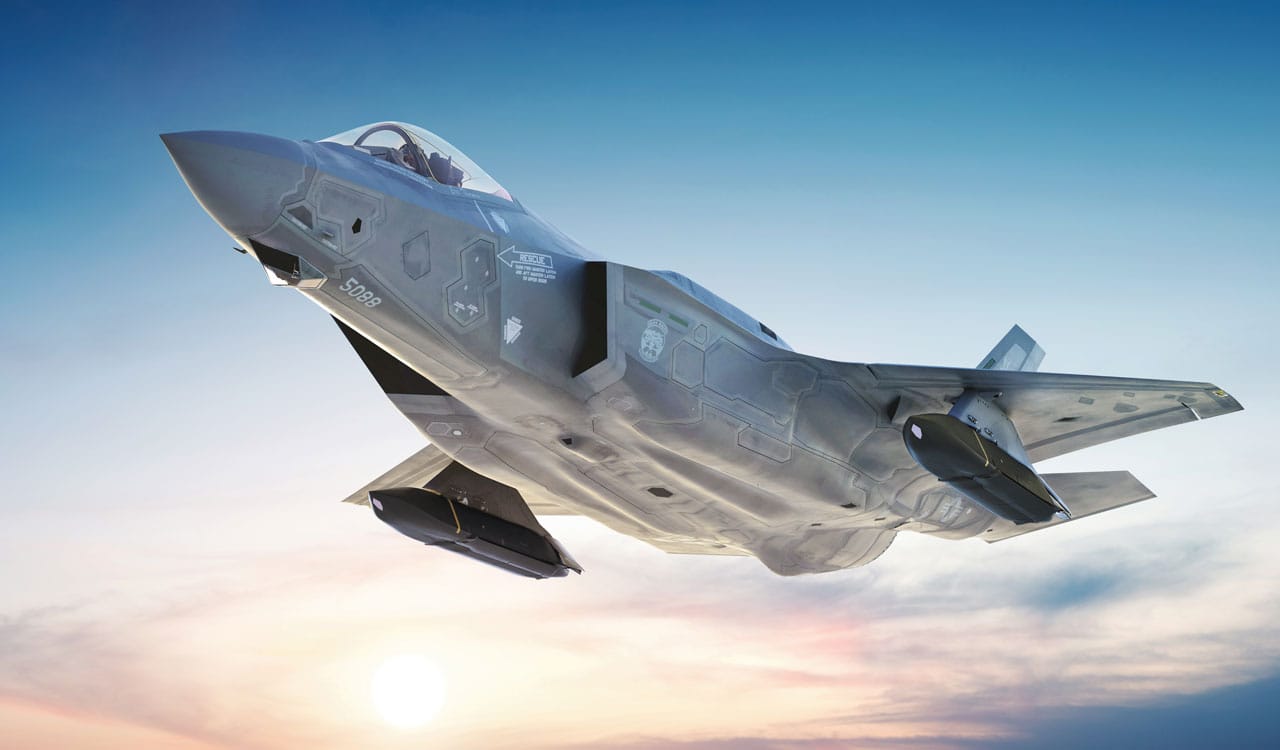
Once individual components are manufactured, the next phase is assembling the three main sections of the aircraft:
- The cockpit section
- The central fuselage
- The rear engine compartment
Each section is covered with stealth coatings designed to absorb radar waves and reduce detection.
Inside enormous assembly hangars, robotic cranes carefully lift these massive sections and position them with extraordinary precision.
A Mechanical Surgery
Technicians and engineers use high-precision digital measurement systems to align every component.
The process is so delicate that it resembles mechanical surgery. Even a small misalignment could affect the aircraft’s aerodynamic stability during flight.
During this phase:
- The wings are attached
- Stabilizers and control surfaces are installed
- Movable aerodynamic components are calibrated
Each wing weighs more than 20 tons and must withstand forces up to nine times the force of gravity during aggressive aerial maneuvers.
At this stage, the aircraft begins to resemble the powerful fighter seen in the sky. Yet internally, it is still just a technological skeleton waiting for its core systems.
“Read Also: كيف أصبح ريد بول أشهر مشروب طاقة في العالم؟ القصة الكاملة من الفكرة إلى الانتشار العالمي“
Installing the Heart: The Engine
Once the structure is complete, engineers install one of the most powerful components of the F-35 fighter jet: the Pratt & Whitney F135 engine.
This advanced engine generates over 40,000 pounds of thrust, enabling the aircraft to achieve near-supersonic speeds.
Specialized Installation Process
Because of its complexity, the engine installation process follows extremely strict safety and quality protocols.
Using hydraulic lifting systems, the engine is carefully inserted into the rear fuselage and secured with precision mounts. Any mistake in this process could lead to severe operational problems.
Vertical Takeoff Capability
One of the most unique versions of the F-35 is the F-35B, which features short takeoff and vertical landing capability (STOVL).
This is made possible through a specialized lift system that redirects engine thrust downward, allowing the aircraft to operate from short runways or amphibious ships.
“Read Also: تصنيع كوكا كولا: رحلة المشروب الأشهر في العالم من السرّ إلى الزجاجة“
Wiring the Aircraft’s Digital Nervous System
After installing the engine, engineers begin building the aircraft’s internal communication network.
The F-35 fighter jet contains more than 80 kilometers of wiring, connecting:
- Sensors
- Flight control systems
- Radar systems
- Electronic warfare units
- Communication modules
These wires are wrapped in specialized insulation designed to:
- Reduce heat emissions
- Prevent electromagnetic interference
- Minimize detectability
Once these systems are connected, the aircraft’s digital operating systems are activated for the first time.
When the engine and electronics power up successfully, the aircraft moves to the next stage of testing.
Weapons Systems and Internal Armament
Unlike traditional fighters, the F-35 fighter jet hides most of its weapons inside internal compartments.
These internal bays open and close within seconds during combat, allowing the aircraft to maintain its stealth characteristics.
Typical armaments include:
- Air-to-air missiles
- Laser-guided bombs
- Precision strike weapons
- A 25mm rotating cannon
By keeping weapons hidden inside the fuselage, the aircraft significantly reduces radar visibility.
“Read Also: كيف تُصنع نوتيلا؟ رحلة صناعة نوتيلا من المزارع إلى البرطمان“
Advanced Sensor Fusion and Battlefield Awareness
One of the most revolutionary aspects of the F-35 fighter jet is its integrated sensor system.
The aircraft is equipped with:
- Infrared sensors
- Thermal imaging cameras
- Long-range radar
- Electronic warfare systems
All of these sensors are connected through a unified digital network that continuously analyzes battlefield data.
Data Fusion Technology
Instead of overwhelming the pilot with raw information, the aircraft’s computer system merges data from multiple sensors into a single tactical picture.
This information is displayed directly on the pilot’s helmet display, providing real-time awareness of:
- Enemy aircraft
- Missile threats
- Radar activity
- Ground targets
This capability transforms the F-35 into what many analysts call a “flying data node” within modern military networks.
Ground Testing and Stress Simulation
Before any F-35 fighter jet is delivered to a customer, it must pass extremely demanding ground tests. Engineers simulate real combat conditions by exposing the aircraft to:
- Strong crosswinds
- Severe vibrations
- Electrical failures
- Structural stress
Massive weights are placed on the wings to simulate the stress of intense combat maneuvers.
Any defect detected during this phase results in immediate rejection and correction.
The First Flight Test
The most critical milestone in the production process is the first flight test.
A highly trained test pilot takes the aircraft into the air and performs a series of aggressive maneuvers designed to simulate real combat conditions.
These tests include:
- High-speed climbs
- Tight turns
- Rapid altitude changes
- Simulated missile evasion
Only after successfully completing these tests does the aircraft receive final operational certification.
Delivery and Customization for Each Country
After passing all tests, the aircraft moves to the delivery stage.
Representatives from the purchasing country arrive to inspect the aircraft and verify that every system meets contractual specifications.
Interestingly, no two F-35 fighter jets are exactly identical.
Each aircraft can be customized with different:
- Software systems
- Sensor packages
- Weapons configurations
- Communication protocols
F-35 Variants
The program includes three main versions:
F-35A: Designed for conventional runway operations.
F-35B: Features short takeoff and vertical landing capability.
F-35C: Built for aircraft carrier operations, with larger wings and reinforced landing gear.
Cost and Scale of the F-35 Program
The F-35 fighter jet program is considered one of the largest military projects in modern history.
Key figures include:
- Unit cost exceeding $120 million per aircraft
- Development costs reaching tens of billions of dollars
- Annual production averaging 140–160 aircraft
More than 1,000 aircraft have already been delivered globally, making the F-35 the most widely deployed stealth fighter today.
Global Operators of the F-35
Several countries operate the F-35 fighter jet, including:
- The United States
- The United Kingdom
- Italy
- Australia
- Japan
- Several European partners
In the Middle East, Israel operates a modified version known as the F-35I.
Currently, no Arab country operates this aircraft in active service.
Can the F-35 Be Disabled Remotely?
A common question about the F-35 fighter jet concerns whether the aircraft can be remotely disabled.
Officially, there is no publicly confirmed system that allows the United States to shut down the aircraft with a single button.
However, the aircraft relies heavily on centralized systems for:
- Software updates
- Logistics management
- Spare parts supply
- Digital maintenance systems
This dependence creates a complex network of technological reliance, giving the manufacturer significant influence through support and update systems.
The Strategic Role of the F-35 in Modern Warfare
In modern conflicts, air power is often determined within the first few hours of combat.
The F-35 fighter jet plays a critical role in these early stages by:
- Disrupting enemy air defenses
- Destroying radar systems
- Targeting command centers
Rather than functioning solely as a missile platform, the aircraft serves as a central intelligence and coordination node for other military forces.
The Ethical Question Behind Military Technology
Despite its remarkable engineering, the F-35 fighter jet also raises an important philosophical question.
The same human intelligence that produced modern medicine, global communication networks, and space exploration is also responsible for developing increasingly powerful weapons.
Is this technological race intended to prevent war through deterrence, or does it continue a historical cycle of building more destructive tools?
Technology itself is neutral. Its impact depends entirely on human decisions.
Frequently Asked Questions About the F-35 Fighter Jet
What makes the F-35 fighter jet stealthy?
The aircraft uses special body shapes, radar-absorbing materials, and internal weapon bays to reduce radar detection.
How fast can the F-35 fly?
The aircraft can reach speeds close to 1,900 km/h, approaching supersonic flight.
How much does an F-35 fighter jet cost?
Each unit costs over $120 million, while the total program costs tens of billions of dollars.
How many F-35 aircraft exist today?
More than 1,000 F-35 jets have been delivered worldwide.
Can the F-35 take off vertically?
Yes, the F-35B variant can perform short takeoffs and vertical landings.
The F-35 fighter jet: Conclusion
The F-35 fighter jet represents one of the most complex engineering achievements in aviation history. From digital simulations and advanced materials to powerful engines and intelligent sensor networks, every aspect of the aircraft reflects decades of technological progress.
Yet behind this incredible machine lies a deeper question about the role of technology in human history. As our ability to build powerful systems grows, so does our responsibility to use them wisely.
The F-35 stands as both a symbol of engineering brilliance and a reminder of humanity’s choices—between protection and destruction, deterrence and conflict.
What do you think about the technology behind the F-35 fighter jet? Would you ever want to pilot such a machine? Share your thoughts and join the discussion.