Updated: October 10, 2026
What if World War 3 doesn’t begin with an official declaration of war, but with a single missile, a naval collision, or a military mistake that nobody intended?
It sounds like the opening scene of a Hollywood thriller. Unfortunately, today’s geopolitical tensions make such scenarios worth examining.
From Russia’s continuing war in Ukraine to growing tensions around Taiwan and the ongoing confrontation between the United States and Iran, several regional conflicts have the potential to draw in major world powers.
The Stockholm International Peace Research Institute (SIPRI) estimated that the world’s nine nuclear-armed countries possessed approximately 12,187 nuclear weapons at the beginning of 2026.
But does that mean World War 3 is approaching?
Not necessarily. While global tensions are serious, a worldwide conflict is not inevitable. The greatest concern is that multiple crises could overlap, turning a regional confrontation into something far more dangerous.
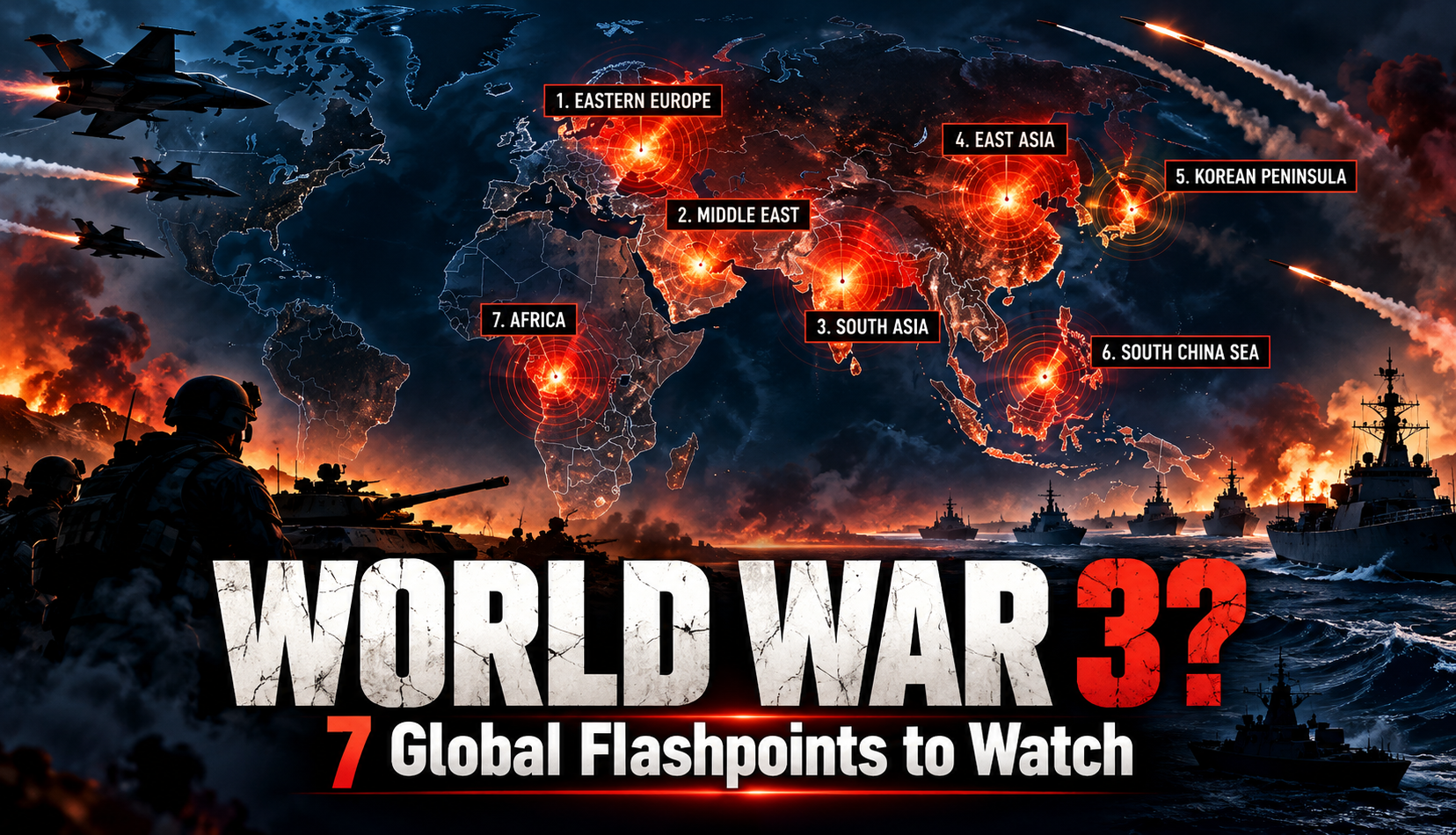
Here are seven global flashpoints that deserve close attention.
1. Russia and NATO: Could the Ukraine War Expand Beyond Its Borders?
The war between Russia and Ukraine remains one of Europe’s most dangerous security crises.
On October 10, 2026, Russian airstrikes killed civilians in the Ukrainian city of Zaporizhzhia, according to Reuters. The latest attacks followed days of deadly bombardment across Ukraine.
But the biggest international concern extends beyond Ukraine itself.
What happens if a Russian missile accidentally strikes a NATO country? Or if a military confrontation involving NATO forces escalates beyond diplomatic control?
NATO’s collective-defense framework means an armed attack against a member could trigger a coordinated response from the alliance.
That does not make every border incident a declaration of war. Nevertheless, it increases the consequences of miscalculation.
The nightmare scenario: A direct clash between Russian and NATO forces could escalate into a wider European conflict involving nuclear-armed powers.
2. China and Taiwan: The Conflict That Could Pull America Into War
Thousands of miles from Ukraine, another dangerous confrontation is developing.
China considers Taiwan part of its territory and has not ruled out using force to achieve unification. Taiwan’s government rejects Beijing’s sovereignty claims and maintains that its future belongs to its people.
On October 10, Taiwanese President Lai Ching-te emphasized that increasing defense spending was intended to deter war rather than provoke it.
Meanwhile, Washington expressed concern about Chinese maritime activity near Taiwan, including movements that Taiwanese officials believe could be connected to preparations for a possible blockade.
A military confrontation could involve the United States, Taiwan’s most important security partner, and potentially affect Japan and other regional powers.
Taiwan also plays a critical role in producing advanced semiconductors used around the world.
The nightmare scenario: A Chinese blockade or military attack triggers a confrontation with American forces, disrupting global technology supplies and international trade.
3. The United States and Iran: A War With Global Economic Consequences
The confrontation between Washington and Tehran has become one of the most serious threats to stability in the Middle East.
After months of conflict, military pressure, disrupted shipping, and fragile diplomatic efforts continue to create uncertainty.
One of the most dangerous locations is the Strait of Hormuz, a narrow waterway essential to global energy transportation.
Attacks on vessels and restrictions affecting maritime traffic have already demonstrated how quickly regional warfare can influence international oil markets.
The danger is not limited to American and Iranian forces.
Additional strikes against Gulf infrastructure, military installations, or commercial shipping could pull neighboring countries further into the confrontation.
Higher energy costs could also affect transportation, food prices, manufacturing, and household budgets worldwide.
The nightmare scenario: A major escalation around the Persian Gulf expands the fighting and causes a prolonged international energy emergency.
4. Israel, Gaza, and Yemen: Could Regional Conflicts Become One Larger War?
The Middle East contains several interconnected conflicts, each carrying its own dangers.
Despite a ceasefire agreement reached in 2025, Gaza continues to experience deadly violence, immense humanitarian suffering, and unresolved political disputes.
Elsewhere, renewed fighting involving Houthi forces in Yemen and Saudi-backed forces has increased threats to regional security.
The Red Sea and the Bab el-Mandeb Strait are particularly important because they connect major international shipping routes.
When attacks threaten these waterways, the consequences extend beyond the countries directly involved.
International shipping, energy supplies, insurance costs, and military deployments can all be affected.
The concern is that separate confrontations may become increasingly interconnected, leaving governments with fewer opportunities to contain escalation.
The nightmare scenario: Intensifying regional conflicts lead to broader military intervention and simultaneous disruptions across several strategic shipping routes.
5. North Korea: The Nuclear Threat That Never Disappeared
While international attention focuses on Ukraine and the Middle East, North Korea continues to develop advanced military capabilities.
On October 3, 2026, North Korean state media reported a hypersonic missile drill supervised by leader Kim Jong Un.
The test highlighted Pyongyang’s determination to strengthen its missile forces and nuclear deterrent.
South Korea, Japan, and the United States closely monitor these developments.
The Korean Peninsula remains particularly sensitive because a military confrontation could escalate rapidly in a densely populated region.
Even without an intentional decision to begin a war, misunderstandings involving missile launches, border incidents, or military exercises could create dangerous situations.
North Korea’s expanding missile capabilities make crisis communication especially important.
The nightmare scenario: A military incident between North and South Korea escalates, drawing in the United States and potentially other regional powers.
6. India and Pakistan: Two Nuclear Powers With a Dangerous Rivalry
India and Pakistan have experienced decades of conflict, particularly over Kashmir.
Both possess nuclear weapons, making any major military confrontation especially alarming.
In May 2025, fighting between the two countries demonstrated how quickly regional tensions could escalate.
The rivalry remains sensitive.
In October 2026, the countries exchanged diplomatic protests following a deadly border incident, with each side offering conflicting accounts of what happened.
Although diplomatic disputes do not automatically lead to war, mistrust can make future crises more difficult to manage.
A terrorist attack, border confrontation, or military miscalculation could increase pressure on political leaders to respond.
The nightmare scenario: A limited border conflict expands into a larger military confrontation between two nuclear-armed neighbors.
7. The South China Sea: The Maritime Dispute That Could Involve the United States
The South China Sea has become another major flashpoint between China and its neighbors.
Beijing’s expansive maritime claims overlap with those of several Southeast Asian countries, including the Philippines.
Recent confrontations involving Chinese and Philippine vessels have highlighted the dangers of increasingly aggressive maritime encounters.
In early October 2026, Philippine authorities confronted a Chinese research vessel operating near the Batanes Islands, close to Taiwan.
What makes these disputes particularly dangerous is the United States’ mutual-defense treaty with the Philippines.
Under existing bilateral defense guidelines, an armed attack against Philippine public vessels, aircraft, or armed forces, including its Coast Guard, could invoke American mutual-defense commitments.
That means an incident involving relatively small vessels could carry enormous geopolitical consequences.
The nightmare scenario: A deadly maritime confrontation triggers a military crisis between China and a US treaty ally.
Could World War 3 Really Happen?
The greatest danger may not be any single conflict.
It is the possibility that several conflicts could escalate simultaneously.
Imagine a serious NATO-Russia confrontation occurring during a Taiwan blockade, while a Middle Eastern war disrupts international energy supplies.
Governments would face competing military commitments, economic emergencies, and intense political pressure.
Cyberattacks, misinformation, and disrupted communications could make decisions even more difficult.
However, military alliances and nuclear arsenals do not automatically make global war inevitable.
Diplomacy, deterrence, crisis-management channels, and economic interdependence still create powerful incentives to prevent catastrophic escalation.
Experts also cannot reliably identify a specific date when a third world war might begin.
Final Thoughts: Is the World Heading Toward Disaster?
World War 3 is not a confirmed future event, and there is no credible basis for claiming that it will begin on a particular date.
Nevertheless, the growing number of international flashpoints deserves serious attention.
Russia and NATO, China and Taiwan, the United States and Iran, the Korean Peninsula, South Asia, and the South China Sea all present different risks.
The most dangerous possibility is not necessarily a carefully planned global war.
It is a chain reaction of decisions, misunderstandings, and escalating military responses.
The question is no longer simply where the next major crisis might happen. It is whether world leaders can prevent separate crises from turning into something much larger.
Which of these seven flashpoints worries you the most?