
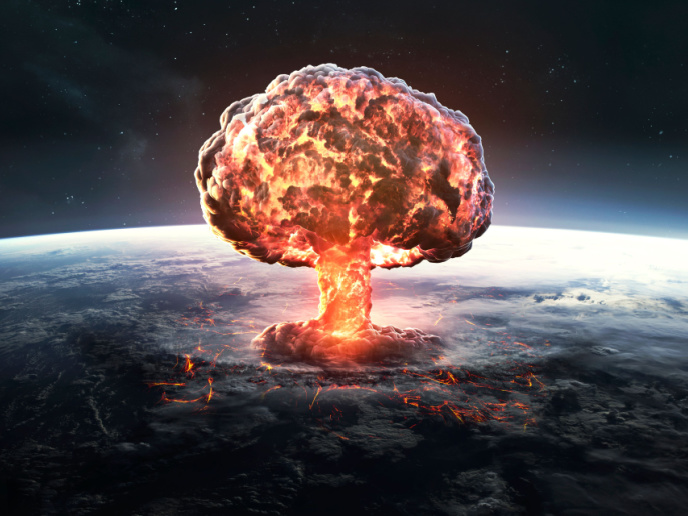
What if the world came dangerously close to nuclear war—not because a country decided to attack, but because a computer made a mistake?
It sounds impossible. Yet history tells a different story.
On September 26, 1983, a Soviet military officer named Stanislav Petrov received an alarming warning: American nuclear missiles appeared to be heading toward the Soviet Union.
The system indicated that an attack had begun.
But Petrov doubted the information. Instead of treating the warning as confirmation of an incoming strike, he reported it as a false alarm.
He was right.
There were no incoming American missiles.
The incident exposed an unsettling reality about nuclear weapons: sophisticated warning systems can make mistakes, and the consequences of misinterpreting those mistakes could be catastrophic.
More than four decades later, the world still faces the possibility of accidental nuclear escalation.
Could a single technical failure, misunderstood missile launch, or military miscalculation help trigger World War 3?
The answer is more complicated—and more disturbing—than many people realize.
1. The Night a Computer Mistake Created a Nuclear Emergency
The 1983 Soviet false alarm remains one of the most remarkable incidents in nuclear history.
During a period of intense Cold War tensions, Soviet early-warning satellites reported what appeared to be an American missile launch.
Additional warnings followed, suggesting several missiles were approaching Soviet territory.
Petrov, the officer responsible for evaluating the information, questioned the reports.
He considered it unlikely that the United States would begin a nuclear attack with so few missiles.
His assessment helped prevent a false warning from moving further through the decision-making process as a confirmed attack.
Investigators later determined that sunlight reflecting off clouds had confused the satellite detection system.
Importantly, Petrov did not personally possess the authority to launch nuclear weapons. His judgment was one part of a much larger command structure.
Nevertheless, the incident demonstrated how human decisions can matter when technology produces dangerous errors.
2. The Norwegian Rocket Incident: Another Nuclear Scare
The Soviet incident was not the only occasion when a harmless event created fears of a nuclear attack.
On January 25, 1995, scientists launched a research rocket from Norway to study the Northern Lights.
Russian radar operators detected the rocket and initially considered whether it might represent a military threat.
Its flight characteristics raised concerns because they resembled aspects of a ballistic missile trajectory.
The warning reached senior Russian officials during the presidency of Boris Yeltsin.
After further assessment, Russian authorities determined that the rocket posed no nuclear threat.
The situation ended without a military attack.
What makes this incident especially significant is that it occurred after the Cold War, when relations between Washington and Moscow had improved.
It proved that nuclear misunderstandings did not disappear with the Soviet Union.
3. A Cheap Computer Chip Once Caused a False Missile Warning
Another disturbing example occurred in the United States.
In June 1980, American early-warning systems generated false indications of an incoming Soviet missile attack.
According to declassified US government documents, investigators traced the problem to the intermittent failure of a microelectronic component worth approximately 46 cents.
The malfunction created erroneous warning information and contributed to heightened military alert measures.
Fortunately, other warning systems did not confirm a Soviet attack.
The alerts were eventually recognized as false.
The incident demonstrates an important lesson: even extremely expensive military systems may depend on small components that can fail.
Modern technology includes additional safeguards, but complex systems remain vulnerable to technical problems.
“Read Also: Is World War 3 Closer Than We Think? 7 Global Flashpoints to Watch“
4. Why Nuclear Weapons Make Military Mistakes So Dangerous
Unlike conventional weapons, nuclear weapons can inflict catastrophic destruction within moments.
According to the Stockholm International Peace Research Institute (SIPRI), nine countries possessed approximately 12,187 nuclear warheads at the beginning of 2026.
Of those, an estimated 2,100 to 2,200 were maintained on high operational alert.
The United States and Russia possess the overwhelming majority of the world’s nuclear weapons.
These arsenals exist partly because governments believe nuclear deterrence discourages adversaries from attacking.
But deterrence also requires countries to interpret threats correctly.
If leaders mistakenly believe an enemy has launched nuclear missiles, they could face enormous pressure to make decisions before the situation is fully understood.
Multiple technical checks, command procedures, and human decisions stand between an alarm and a nuclear launch.
A single malfunction would not automatically start a nuclear war.
The danger emerges when technical failures interact with political tensions, uncertainty, and additional mistakes.
5. Could Artificial Intelligence Increase Nuclear Risks?
Artificial intelligence is becoming increasingly important in military analysis, surveillance, and intelligence processing.
Advanced systems can examine enormous quantities of information much faster than human analysts.
These capabilities may help identify threats and improve situational awareness.
However, AI systems can also generate inaccurate conclusions, misinterpret unusual events, or produce outputs that are difficult to explain.
Imagine a military crisis involving incomplete satellite information, conflicting intelligence reports, and rapidly changing battlefield conditions.
An AI-supported system might produce a confident but incorrect assessment.
If officials relied too heavily on that assessment, the misunderstanding could become dangerous.
This does not mean artificial intelligence currently controls nuclear-launch decisions.
The central concern is whether increasing automation could introduce new errors or intensify existing weaknesses in nuclear command systems.
Maintaining meaningful human judgment remains an important objective in discussions about nuclear safety.
6. What Happens if One Country Misunderstands a Missile Launch?
Not every missile carries a nuclear warhead.
Countries routinely test conventional missiles, conduct military exercises, and launch scientific rockets.
Yet during periods of intense hostility, interpreting these activities correctly can become difficult.
Some delivery systems can carry either conventional or nuclear weapons, making their intended use harder to determine from limited information.
A government might initially struggle to establish whether an incoming missile represented a conventional strike or something more serious.
Misunderstandings could become especially dangerous if communication channels between rival countries were disrupted.
The most worrying scenario involves multiple failures occurring together: incomplete intelligence, heightened military readiness, and leaders interpreting ambiguous events as hostile intentions.
That combination could increase the risk of escalation even when neither side originally intended a nuclear confrontation.
7. Why Nuclear War Concerns Remain Serious in 2026
The risks surrounding nuclear weapons are not merely historical.
In January 2026, the Bulletin of the Atomic Scientists moved its symbolic Doomsday Clock to 85 seconds before midnight, its closest position to midnight since the clock was introduced.
The organization cited nuclear tensions, emerging technologies, and deteriorating international cooperation among the threats influencing its assessment.
The clock is not a literal countdown or a statistical prediction of nuclear war.
Nevertheless, it reflects expert concern about growing global risks.
Meanwhile, the New START treaty, which limited deployed strategic nuclear weapons between the United States and Russia, expired in February 2026 without a replacement.
Its expiration removed an important element of the bilateral nuclear arms-control framework.
Rising geopolitical tensions and advances in missile technology have added further complications.
These developments do not establish that nuclear war is imminent, but they reinforce the importance of communication, transparency, and reliable warning systems.
8. Could a Small Nuclear Incident Trigger World War 3?
A nuclear detonation during a military confrontation would create extraordinary pressure on governments worldwide.
The consequences would depend on the location, scale, circumstances, and decisions taken afterward.
Some leaders might consider retaliatory military action.
Others could seek emergency negotiations to prevent further nuclear use.
International organizations would likely call for immediate restraint.
Financial markets, international transportation, and global security arrangements could experience severe disruption.
However, an isolated nuclear incident would not automatically lead to a worldwide nuclear exchange.
The possibility of escalation is real, but there is no predetermined sequence forcing every country into war.
That distinction matters because diplomacy could still prevent an already devastating crisis from becoming an even larger catastrophe.
9. How Can the World Reduce the Risk of Accidental Nuclear War?
Preventing accidental nuclear escalation requires more than sophisticated technology.
Reliable warning systems must be supported by independent verification, clear command procedures, and effective communication between governments.
Military authorities need ways to distinguish routine activities from genuine attacks.
Maintaining diplomatic and military communication channels can help clarify intentions during emergencies.
Arms-control agreements, transparency measures, and risk-reduction discussions may also reduce uncertainty.
Perhaps most importantly, decision-makers need enough reliable information to avoid treating unconfirmed warnings as established facts.
The historical incidents involving Petrov, the Norwegian research rocket, and American computer failures illustrate why caution and verification remain essential.
Final Thoughts: The Most Dangerous Mistake Humanity Could Make
Nuclear war does not have to begin with a carefully planned decision to destroy another country.
A serious crisis could develop through a chain of technical failures, misunderstood warnings, military actions, and human errors.
History proves that false alarms have occurred.
It also shows that those alarms can be questioned, investigated, and resolved without nuclear weapons being used.
That is why the answer to the central question is both alarming and important.
Yes, a mistake could contribute to a chain of events leading toward nuclear war. But a single error does not automatically trigger a nuclear launch.
Human judgment, reliable safeguards, and diplomacy remain essential defenses against catastrophe.
And perhaps the most unsettling thought of all is this:
The next nuclear crisis might begin not with an enemy missile—but with a warning that turns out to be wrong.