
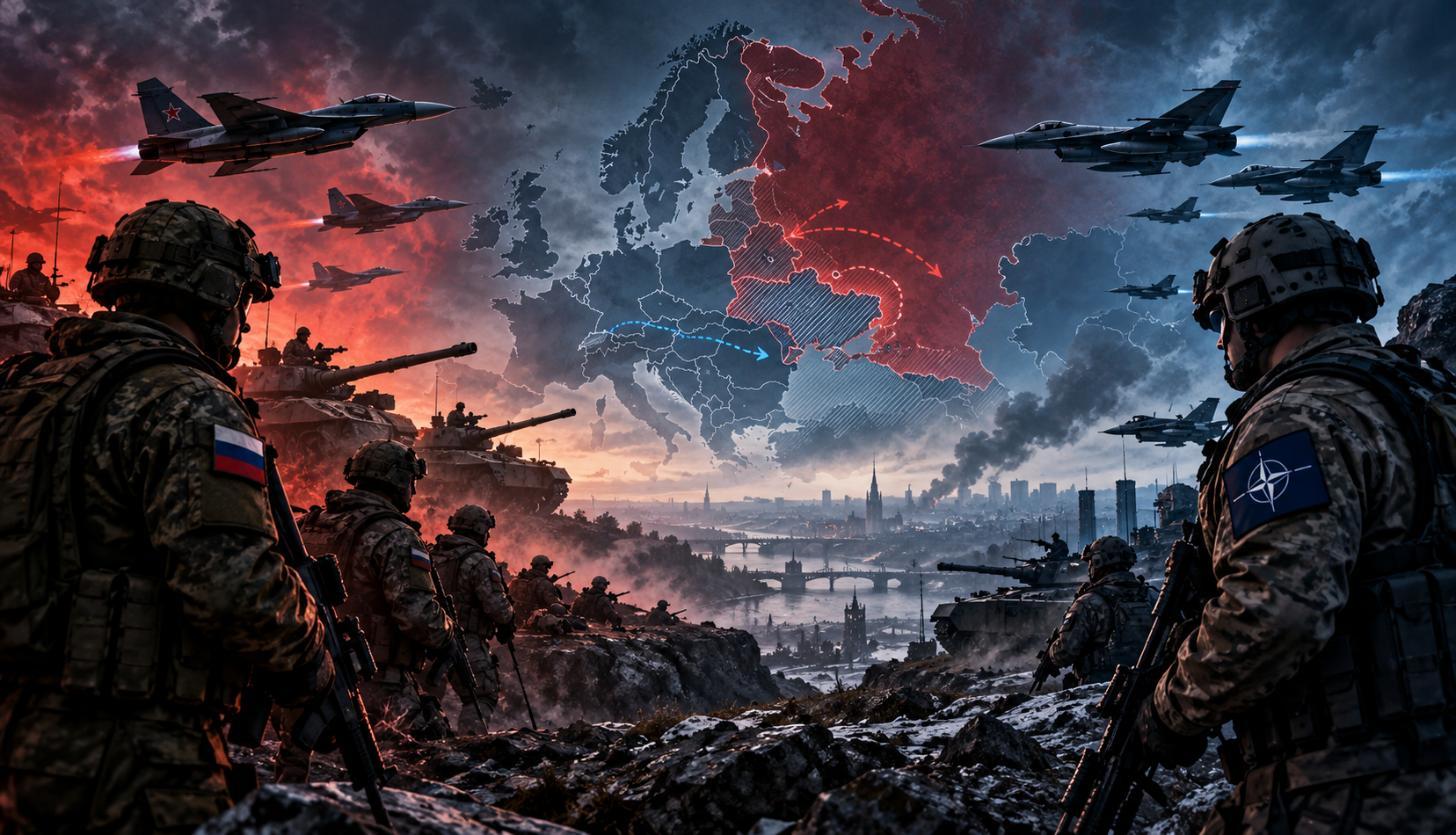
Imagine waking up to breaking news that Russian and NATO forces have exchanged fire somewhere in Eastern Europe.
Within minutes, financial markets begin reacting, military aircraft scramble, emergency diplomatic calls take place, and governments across Europe prepare for an uncertain confrontation.
Then comes a frightening question:
Could this be the beginning of World War 3?
For decades, NATO and Russia have avoided a direct, sustained military conflict. But Russia’s continuing war in Ukraine, growing military tensions along Europe’s eastern borders, and increasingly sophisticated weapons have made the consequences of miscalculation a major international concern.
On October 5, 2026, Germany’s foreign intelligence chief warned about the possibility of violent confrontation with Russia, citing growing security threats and activities described as hybrid warfare.
Just one day later, Sweden announced plans to deploy Patriot air-defense systems to protect a NATO logistics hub in Poland.
These developments do not mean war is inevitable. However, they illustrate why European governments are strengthening their defenses.
So what would actually happen if Russia and NATO entered a direct military conflict?
1. The First Military Clash Could Trigger an International Emergency
A direct confrontation might begin with a relatively small incident.
Imagine a Russian military aircraft entering NATO airspace and becoming involved in an armed confrontation. Alternatively, a missile could strike territory belonging to a NATO member, prompting an urgent investigation.
The immediate response would depend on the circumstances.
Military commanders would attempt to establish what happened, whether the incident was deliberate, and whether additional attacks were expected.
National governments could increase military readiness while requesting emergency NATO consultations.
Article 4 of NATO’s founding treaty allows member countries to consult when their security or territorial integrity is threatened.
If the situation involved an armed attack covered by Article 5, collective-defense obligations could become relevant.
The crucial question would be whether both sides could prevent an isolated incident from developing into sustained military operations.
“Read Also: Could One Mistake Trigger a Nuclear War? The Dangerous Reality“
2. Would NATO’s Article 5 Mean an Automatic World War?
One of the biggest misunderstandings about NATO involves Article 5.
The principle is straightforward: an armed attack against one NATO member is considered an attack against all.
However, that does not mean every member automatically declares war or launches an identical military response.
According to NATO’s official explanation, each country determines what assistance it considers necessary, which may include military force.
Possible responses could involve strengthening air defenses, deploying additional troops, providing intelligence, or taking other defensive measures.
The alliance would coordinate its decisions while evaluating the seriousness of the confrontation.
This distinction matters because collective defense is intended to deter aggression, not make uncontrolled escalation unavoidable.
Nevertheless, a direct military clash involving Russia and NATO forces would create pressure on leaders to demonstrate resolve without triggering a much wider conflict.
3. Eastern Europe Could Become the Center of the Conflict
If fighting expanded, Eastern Europe would be an obvious area of concern.
Poland, Lithuania, Latvia, Estonia, and Finland are NATO members positioned close to Russia or Belarus.
The Baltic region is particularly sensitive because of its geography, military infrastructure, and proximity to Russia’s Kaliningrad exclave.
The Black Sea could also become strategically important because several NATO countries have territory or coastlines in the wider region.
Air-defense systems, surveillance aircraft, naval forces, and military logistics would become increasingly significant.
Both sides would face difficult decisions about troop movements, defensive operations, and the protection of military installations.
Civilian airports and commercial shipping routes might experience restrictions.
Countries nearest the confrontation could introduce additional security measures and emergency warnings.
Yet the scale of fighting would depend on political decisions and military objectives. A limited border incident would not necessarily become a continent-wide war.
“Read Also: Is World War 3 Closer Than We Think? 7 Global Flashpoints to Watch“
4. Cyber Warfare Could Affect Millions Without a Single Missile
Modern warfare does not take place exclusively on the battlefield.
A direct Russia-NATO confrontation could involve cyber operations, electronic interference, and information warfare.
Possible targets might include government networks, communication systems, transportation infrastructure, and financial institutions.
Some services could experience interruptions, depending on the scale and success of individual attacks.
False information could spread rapidly online.
Fabricated emergency announcements, manipulated videos, and misleading reports about military movements might increase public confusion.
However, widespread internet outages or the collapse of entire national power grids should not be treated as inevitable outcomes.
The major concern is that cyber incidents could complicate military decision-making and create uncertainty about who was responsible.
In an already tense confrontation, confusion itself could become dangerous.
5. The Global Economy Could Face an Immediate Shock
Even countries far from Europe could experience economic consequences.
International investors might react to the possibility of a prolonged military confrontation involving some of the world’s most powerful countries.
Energy markets could face renewed uncertainty, especially if the fighting threatened European infrastructure or international shipping.
Airlines might cancel or reroute flights through affected airspace.
Insurance costs for vessels operating near conflict zones could rise.
Companies dependent on European manufacturing, transportation networks, and international trade might begin preparing for disruptions.
American consumers could eventually feel the effects through changes in fuel prices, investment markets, or imported goods.
However, the magnitude of the disruption would depend on how far the confrontation spread and how long it lasted.
A sudden worldwide economic collapse would not be a guaranteed result.
6. The Nuclear Question Would Become the Biggest Fear
Perhaps the most dangerous aspect of a Russia-NATO military conflict would be the presence of nuclear weapons.
Russia and the United States possess the world’s largest nuclear arsenals.
According to the Stockholm International Peace Research Institute, the two countries together controlled approximately 83% of the world’s stockpiled nuclear warheads at the beginning of 2026.
NATO also includes two other nuclear-armed countries: the United Kingdom and France.
The possibility of escalation would therefore carry consequences far beyond conventional warfare.
A military confrontation could generate fears that one side might misinterpret the other’s intentions or perceive an existential threat.
However, direct conventional fighting would not automatically lead to nuclear weapon use.
Nuclear deterrence, military restraint, and crisis communication are intended to discourage exactly that outcome.
The greatest danger would arise if decision-makers concluded that escalation was necessary or mistakenly interpreted defensive actions as preparations for a larger attack.
7. Would the United States Be Drawn Into the Fighting?
The United States is a founding member of NATO and provides major military capabilities to the alliance.
A direct attack against a NATO ally could therefore present Washington with urgent collective-defense responsibilities.
American forces stationed in Europe might be involved in defensive measures, depending on decisions made by US and allied leaders.
Additional military assets could be deployed to reinforce threatened countries.
The US government might also increase security around military facilities and critical infrastructure.
For ordinary Americans, the immediate effects could include heightened national security alerts, financial volatility, and disruptions to international travel.
Importantly, a Russia-NATO clash would not mean that American cities would automatically face missile attacks.
The consequences for US territory would depend on the nature and scope of the conflict.
8. Could Other Countries Become Involved?
One of the greatest fears surrounding a major European war is that it could overlap with other international crises.
Governments around the world would reassess their military commitments and diplomatic positions.
Countries with economic or security relationships involving Russia or NATO might face pressure to respond.
China, for example, would have significant interests in avoiding severe disruptions to global trade, even while maintaining its own strategic relationship with Moscow.
But military involvement by additional countries would not be automatic.
A global war would require further political and military developments beyond an initial European confrontation.
That distinction is essential when evaluating claims that any Russia-NATO incident would immediately trigger World War 3.
9. Could Diplomacy Stop the Conflict Before It Escalates?
Despite the serious risks, a direct military confrontation would not necessarily eliminate opportunities for diplomacy.
Emergency communication between Washington, Moscow, and European capitals could help clarify intentions.
Military officials might attempt to establish procedures to avoid further accidental encounters.
Governments could negotiate limited ceasefires, withdrawals, or restrictions on particular military activities.
International institutions could facilitate discussions, although their effectiveness would depend on cooperation between the countries involved.
Even during periods of severe hostility, rival powers have strong incentives to avoid a catastrophic confrontation.
The first hours and days could therefore involve military preparations and intense diplomatic negotiations at the same time.
Final Thoughts: Could a Russia-NATO War Trigger World War 3?
A direct military conflict between Russia and NATO would represent one of the most serious international security crises in decades.
Its consequences could include military escalation in Europe, cyber disruptions, economic instability, humanitarian emergencies, and heightened nuclear risks.
But none of those outcomes should be presented as predetermined.
The difference between a limited confrontation and a much larger war would depend heavily on political decisions, military restraint, and diplomatic communication.
For now, Russia and NATO remain adversaries facing major disagreements, but a full-scale war between them is not an established future event.
The most frightening possibility is not necessarily that either side wants World War 3. It is that a series of mistakes could create a confrontation neither side initially intended.
And that leaves one question:
If Russian and NATO forces exchanged fire tomorrow, could world leaders stop the escalation before it was too late?


