
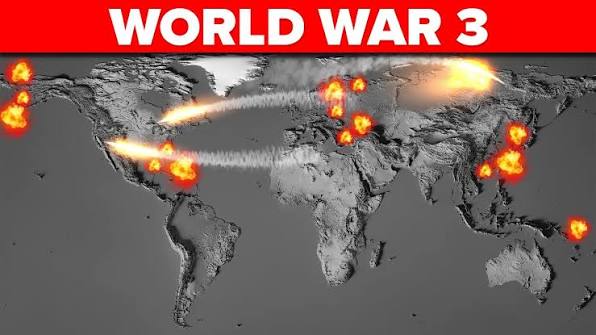
Imagine waking up to an emergency alert on your phone. Television networks interrupt their broadcasts. World leaders deliver urgent statements. Financial markets begin reacting to reports of military attacks involving major global powers.
Then comes the question nobody wants to ask: Has World War 3 actually begun?
For decades, movies have portrayed a third world war as an instant nuclear apocalypse. But the reality could be far more complicated, involving conventional military strikes, cyberattacks, diplomatic emergencies, economic disruption, and the growing possibility of nuclear escalation.
According to the Stockholm International Peace Research Institute (SIPRI), the world’s nine nuclear-armed countries possessed an estimated 12,187 nuclear warheads at the beginning of 2026.
That makes any direct confrontation between nuclear powers extraordinarily dangerous.
So what would the first 24 hours of World War 3 actually look like?
The following timeline explores one hypothetical scenario, based on modern military capabilities, documented geopolitical risks, and emergency-response guidance. It is not a prediction of a future war.
Hour 0–1: The Incident That Changes Everything
A global conflict might begin with an event that initially appears regional.
Imagine a major military confrontation between two powerful countries. An aircraft is shot down, a naval vessel is struck, or missiles hit military installations near an internationally disputed border.
Both governments accuse the other of aggression.
Within minutes, military commanders assess the situation, intelligence agencies attempt to establish what happened, and national leaders receive urgent briefings.
Diplomatic communication becomes critically important.
If the incident involves a NATO member, emergency consultations could follow. However, NATO’s Article 5 does not automatically require every member to declare war. Each ally determines the assistance it considers necessary.
The first hour could determine whether the crisis remains limited or begins expanding beyond its original battlefield.
“Read Also: What Happens if Russia and NATO Enter a Direct Military Conflict?“
Hours 1–3: Military Forces Move to Higher Alert
As the situation develops, governments could begin strengthening military readiness.
Fighter aircraft might be repositioned, naval forces placed on heightened alert, and air-defense systems activated in threatened regions.
Military communications would become essential as commanders attempt to distinguish genuine attacks from false alarms.
Meanwhile, world leaders could open emergency communication channels to prevent misunderstandings.
For ordinary people, the first signs might appear through breaking-news notifications rather than explosions.
Headlines announcing military clashes between major powers could dominate television, websites, and social media.
Some governments might warn residents near threatened military installations or borders to remain indoors.
Others could advise citizens abroad to avoid certain areas.
Yet heightened military readiness would not necessarily mean that nuclear weapons were about to be used.
“Read Also: Could One Mistake Trigger a Nuclear War? The Dangerous Reality“
Hours 3–6: Cyberattacks and Information Warfare
Modern warfare extends far beyond tanks, aircraft, and missiles.
During a major international confrontation, cyber operations could target communications networks, government systems, transportation providers, and other critical infrastructure.
Depending on the conflict, some regions might experience temporary service interruptions.
Banking applications could become unreliable. Airport systems might face disruptions. Government websites could be overwhelmed by traffic or malicious activity.
However, the entire global internet would not automatically shut down.
The greater immediate problem might be uncertainty.
Social media could fill with unverified videos, fabricated military announcements, misleading maps, and rumors about attacks that never occurred.
Artificial intelligence could make deceptive recordings and images increasingly convincing.
Millions of people might struggle to distinguish legitimate emergency warnings from misinformation.
In the opening hours of a global crisis, reliable information could become one of the most valuable resources available.
Hours 6–12: Financial Markets React to the Crisis
Even countries far from the fighting could begin experiencing economic consequences.
Investors might sell risky assets, while demand could increase for traditional safe-haven investments.
Oil and natural gas prices could rise sharply if major energy-producing regions or shipping routes were threatened.
International airlines might reroute flights around dangerous airspace.
Shipping companies could suspend voyages through contested waterways, creating uncertainty for global supply chains.
Businesses dependent on imported fuel, electronics, or industrial components would begin assessing their exposure.
The International Monetary Fund has already documented how major conflicts can disrupt energy markets, financial conditions, and international trade.
However, the scale of any financial shock would depend on where fighting occurred, which countries participated, and whether critical infrastructure was damaged.
An immediate worldwide economic collapse would not be guaranteed.
Hours 12–18: Civilians Begin Preparing for the Unknown
As the conflict develops, public anxiety could intensify.
In countries directly threatened by military action, emergency services might prepare shelters, hospitals, and evacuation centers.
Some families could attempt to leave major cities or vulnerable border regions.
Supermarkets and gas stations might experience sudden increases in demand as people purchase essential supplies.
Governments could issue instructions covering emergency communications, transportation restrictions, or civil-defense measures.
Conditions would vary enormously.
People thousands of miles from the fighting might experience little immediate physical danger, even while following developments with concern.
For residents near active combat zones, however, the consequences could already be severe.
Civilian safety would depend on the location and intensity of attacks, the availability of functioning infrastructure, and the effectiveness of emergency services.
Hours 18–24: The Nuclear Question Becomes Impossible to Ignore
Perhaps the most frightening question would emerge as the crisis continues:
Could one of the nuclear powers decide to use a nuclear weapon?
The answer would depend on political decisions, military circumstances, and efforts to contain the conflict.
A conventional war between nuclear-armed states does not automatically become a nuclear war.
Still, the possibility of miscalculation makes escalation especially dangerous.
SIPRI estimates that thousands of nuclear warheads remain deployed globally, with some maintained at high operational readiness.
If a nuclear weapon were detonated near a populated area, the consequences could include catastrophic destruction, radiation exposure, and overwhelming pressure on emergency services.
The International Committee of the Red Cross warns that no adequate humanitarian response capacity exists for such devastation.
In an affected area, US Centers for Disease Control and Prevention guidance advises people facing radioactive fallout to get inside, stay inside, and follow official instructions. Sheltering for at least 24 hours may provide important protection.
But nuclear escalation is only one possible outcome.
Diplomatic negotiations, military restraint, and emergency communication could also prevent the conflict from reaching that point.
What Would Happen to the United States?
For Americans, the consequences of a global war would depend heavily on whether the United States became directly involved and whether its territory was threatened.
Possible immediate effects might include:
- Heightened security around military facilities and important infrastructure.
- Emergency government announcements and increased military readiness.
- Disruptions to international flights, shipping, and financial markets.
- Cybersecurity warnings affecting businesses and public institutions.
- Increased fuel prices and uncertainty about future supplies.
A global conflict would not mean every American city would immediately become a battlefield.
The risks would differ significantly between a conventional overseas war and a direct attack on American territory.
Could World War 3 Be Stopped During the First 24 Hours?
Yes. Even a severe confrontation between major military powers would not make worldwide war inevitable.
Diplomatic channels could remain active while military forces prepared for further action.
Governments might negotiate temporary ceasefires, clarify misunderstandings, or agree to restrict military operations.
International organizations could call emergency meetings.
Allies might encourage restraint rather than additional attacks.
In fact, decisions made during the first day could be crucial in preventing a regional conflict from becoming a much larger war.
The same modern technologies that make warfare increasingly dangerous also support rapid communication between governments.
Final Thoughts: The Most Dangerous 24 Hours in Modern History?
Nobody can predict exactly how World War 3 would begin, which countries would participate, or what would happen during its first day.
A future global conflict might involve coordinated military attacks. It might develop gradually from several overlapping crises. Or a confrontation could be contained before it spreads.
What makes modern warfare uniquely dangerous is the combination of powerful conventional weapons, cyber capabilities, economic interdependence, and nuclear arsenals.
The opening 24 hours would likely be defined not only by military actions but also by urgent efforts to understand events and prevent further escalation.
The most important question is not how quickly World War 3 could begin. It is whether governments could stop the fighting before the consequences became irreversible.
And if such a crisis began tomorrow, how prepared would the world really be?


